


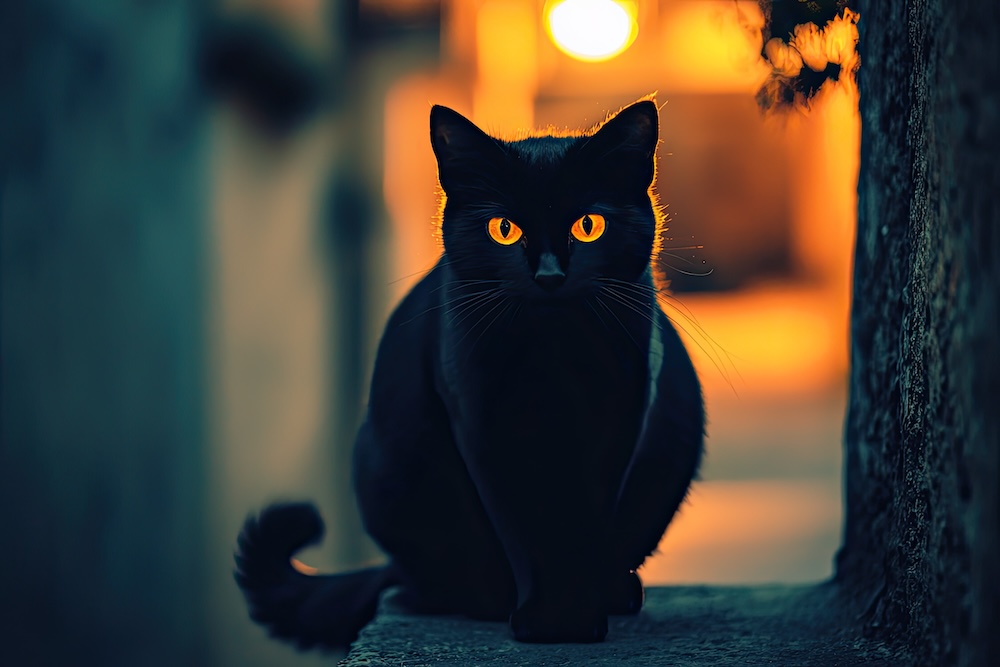
Step into the shoes of a cat for a moment. Imagine moving through the house without making a sound, gliding like a curious shadow. You don’t need to see all the colors. You don’t need a flashlight to move in the dark. What you need is focus, breadth, and sharpness for things others don't even notice. This is how cats see: a visual system designed for stalking, vigilance, and mystery.
Sometimes, when you look at them closely, it seems like their eyes know everything. But… what do they really see? How do they interpret the world they share with us? Today, we sneak in, without asking permission, into the retina of felines.
I. A different gaze: how cats perceive the world
The architecture of the feline eye
Cat eyes are not just pretty. They are precision instruments designed for survival. They are larger in proportion to their heads and have a vertical pupil that adapts with surprising speed to ambient light. In fact, that slit-shaped pupil is key to controlling light entry, narrowing into a thin line in the sunlight and opening wide like a door to the underworld when the shadows rule.
Key differences with human vision
Where we see a spectrum of vibrant colors, they operate in a more contained range. Where we need to turn on the light, they’ve already detected the movement of a fly in the shadow.
In short, their visual world is less detailed in terms of sharpness and color, but much more efficient in what matters for a predator: movement, shape, and opportunity.
II. The feline spectrum: colors and contrasts
Muted tones, tactical advantages
No, cats do not see in black and white. But neither do they see the world like a Van Gogh painting. Their color spectrum is limited, basically, to blue and green. Warm tones like red, pink, or orange slip past them; they perceive them more as shades of gray or muted yellow.
Far from being a flaw, this gives them an evolutionary advantage. By not being distracted by an extensive color palette, their vision focuses on what truly matters: movements, contrasts, and details that escape the human eye.
The value of the subtle
Where we see a green bush and a camouflaged prey, they detect the slightest flicker. A slight tremble in a leaf may reveal prey. Their sensitivity to contrast allows them to detect subtle, almost imperceptible changes. And that turns them into silent hunting machines.
III. When the sun sets: the prodigious night vision of cats
Tapetum lucidum: the secret lens of nocturnal hunters
Here’s where the magic happens. Cats see about six times better than humans in the dark. And all thanks to that reflective layer in their eyes, the famous tapetum lucidum. This layer acts like a mirror, reusing the little light available and sending it back to the receptor cells.
That’s why, although they can’t read a book in the dim light (nor do they want to), they can see clearly enough to catch a moth at midnight.
Photoreceptors in favor of stealth
The cat’s eye is filled with rods—light-sensitive cells—far more than cones, which are responsible for color. This distribution allows them to detect movement in very low light levels.
So while you stumble around the table looking for the switch, your cat has already run after something you didn’t even know was there.
IV. Beyond the face: an expanded field of vision
Open horizons, constant vigilance
The vision of cats has a field of view of about 200 degrees, much wider than ours, which is around 180. This small detail makes a big difference in feline life: while you turn your head to see who is approaching, they’ve already seen it coming out of the corner of their eye.
This allows them to maintain constant vigilance, even when they seem to be sleeping or lying on their backs.
Peripheral hunting
Have you ever noticed that sometimes your cat seems to be staring into space, but then suddenly leaps at a target? That’s because their peripheral vision is finely tuned to the environment. They can detect small prey moving at the edges of their vision without having to look directly at them. This type of peripheral perception helps them anticipate, plan a jump, and react right before the perfect moment.
V. Cat vision and behavior: explorers of the silent world
A visual map at the service of instinct
All of this is not an evolutionary luxury, but a need deeply ingrained in their genetics. Every detail of their vision serves their instinct: to prowl stealthily, climb precisely, and stalk in silence. Even though they live surrounded by domestic comforts, they still see the world as if they had to survive in it.
That’s why they explore, jump, hide, and observe. Their vision is their guide, their invisible map, their best ally. And to keep up with their tireless explorer rhythm, they need a diet that supports their energy without compromising their health.
An excellent choice for active and curious adult cats is Ownat Ultra Adult Cat, a complete food made with natural ingredients and high-quality proteins. It is formulated to support their agility, musculature, and daily vitality — the energy they use, among other things, to follow every moving shadow and climb to the highest spot on the cupboard like it’s their personal watchtower.
Nighttime routines and invisible territories
Many cats are more active in the evening or even at night. Their world wakes up when ours sleeps. They walk with the same confidence during the day and night because, literally, they can afford it.
And even though your house might be small, to them it’s full of secret paths, routes you don’t see, corners watched from the perfect angle. Their vision influences their habits, their games, and even the way they watch you. Yes, they see you... even when you can’t see them.
A less colorful universe, but more alive
Cat vision doesn’t need bright colors or perfect definition. It’s enough with shadows, contrasts, soft light, and subtle movements. What we consider “seeing little,” they turn into a tactical advantage.
Their eyes aren’t looking for beauty, they’re looking for utility. Where we admire, they evaluate. Where we look, they calculate. And in that silent calculation lies part of the mystery that fascinates us so much about cats: their ability to be present, to stalk without being seen, to move as if they know something you don’t.
Because yes… they probably do.


