


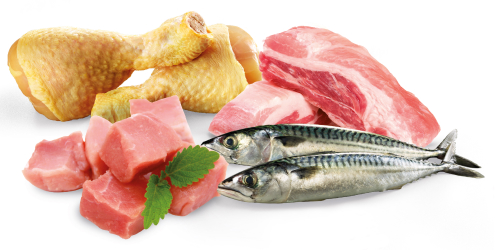
WHY IS IT SO IMPORTANT TO INCLUDE FRESH MEAT IN THE FEED FOR OUR PETS?
As you know, dogs and cats are carnivores and therefore their diet must be mainly based on meat. In order for their bodies to benefit fully from meat proteins, the proteins must be from fresh meat since in this way they provide:
- Proteins of higher nutritional quality, with high biological value as they contain all the essential amino acids that are essential for the proper development and functioning of dog and cat metabolism.
- More digestible proteins as the body takes advantage of a higher percentage of nutrients by reducing the volume of faeces.
- Most appetizing proteins, the naturally preferred flavour for our animals is fresh meat.
Our fresh meats have not undergone any prior industrial processing and has followed the same health checks as those aimed at human consumption.
WHAT KIND OF FRESH MEAT DOES OWNAT USE?
Mainly fresh chicken and turkey meat since these have proteins of greater biological value as they contain all the essential amino acids, as well as being more easily digestible.
In our recipes we use:
• Muscles that are a source of proteins, fats, vitamins A, B, D and K, and minerals such as copper, chromium, iron, magnesium, potassium, selenium and zinc.
• Viscera: incorporate essential vitamins, minerals, healthy fats and amino acids.
• Bone and cartilage: they are a natural and easy to absorb source of minerals such as calcium, phosphorus, magnesium and potassium.
• We never use feathers, legs and beaks.
In addition, for certain feed varieties, we use other fresh meats such as lamb and pork and fish, which also provide high biological value, to meet specific functional needs.
WHY DO ANIMALS NEED A PROTEIN-RICH DIET?
Both dogs and cats need a protein-rich diet for proper development and maintenance of muscle, bone system, skin and hair.
Animal anatomical and physiological characteristics are clearly suited for the consumption of high protein diets based on meat:
• Jaws and short pointed teeth, designed to grip and tear.
• A much shorter digestive tract, designed for rapid digestion of raw meats and fats. With enzymes and gastric juices suitable for digesting meat.
WHAT IS THE BIOLOGICAL VALUE OF A PROTEIN?
Protein quality is measured by its biological value. The biological value of a protein refers to the amount and type of essential amino acids it contains and, in addition, ease of digestion and metabolic capacity, which allow greater use of nutrients and lower generation of waste.
Since the body cannot produce essential amino acids, they must be obtained from food.
The more amino acids a protein contains, the higher its quality.
HOW MUCH PROTEIN SHOULD PETS CONSUME?
In general, an adult dog of medium size in a maintenance regime, needs a minimum of 3 grams of protein per kilo of weight, while cats need 5 grams per kilo of body weight.
However, healthy dogs and cats can tolerate very high amounts of protein in their diet without any harm to their metabolism.


