


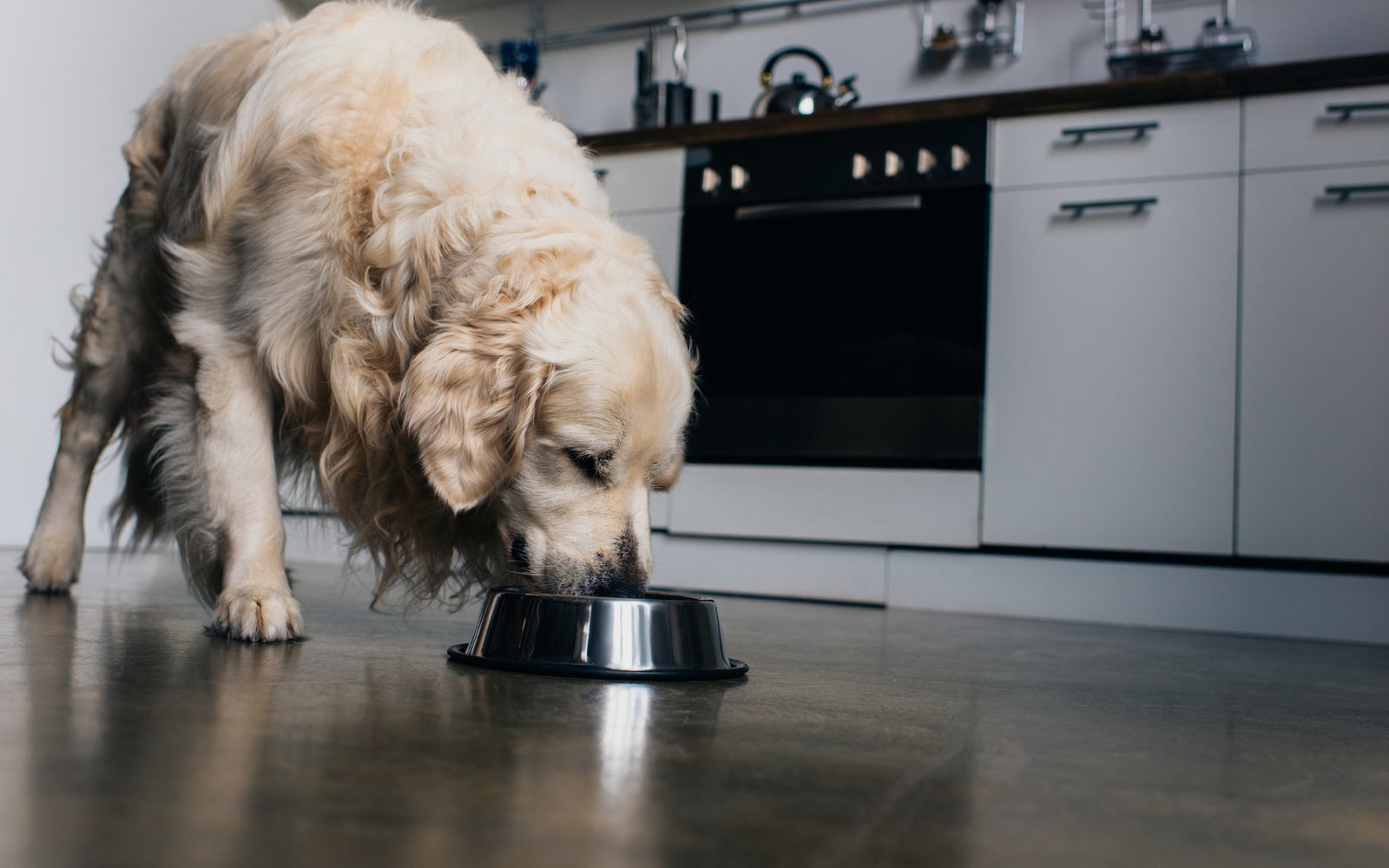
A dog that eats anxiously is almost always responding to something in their daily routine. They may be arriving at mealtime overly hungry, unsure when the next meal will come, worried that another animal might take their food, or simply too excited after playtime. That’s why, before assuming there is a health problem, it’s worth reviewing how, when, and where your dog eats. In most cases, a few adjustments to feeding schedules, portion sizes, and the eating environment are enough to help them eat more calmly.
Here’s what to look at, and in what order: why food anxiety develops, how many meals an adult dog needs, how to check whether the portion size is appropriate, what you can do to slow down eating, and which signs indicate it’s time to visit the veterinarian.
Why Does a Dog Eat Anxiously?
A dog eats anxiously when food feels like a scarce or unpredictable resource, and this is usually linked to routine rather than personality. The most common causes are feeding only once a day, which leaves the dog very hungry; inconsistent meal times; the presence of another dog or a cat near the food bowl; and highly stimulating situations immediately before meals, such as returning from a walk or greeting someone arriving home.
Boredom can also play a role. For a dog with limited stimulation, mealtime may be the highlight of the day. Dogs that have experienced food scarcity or competition in the past may continue gulping down their food for years as a learned habit. If your dog also hides part of their food, it may be related to the same instinct, and we explain why some dogs hide their food.
How Many Times a Day Should a Dog Eat?
Most adult dogs do well with two meals per day, spaced about eight to twelve hours apart and served at consistent times. Dividing the daily ration into two meals helps prevent long periods with an empty stomach and reduces the tendency to rush through meals, which is common in dogs fed only once daily.
Puppies require more frequent meals because they have limited stomach capacity and higher energy requirements. Consistency is just as important as the number of meals. A dog that knows when food is coming does not feel the need to treat every meal as if it were the last.
If your schedule changes significantly between weekdays and weekends, try to keep at least the main meal at the same time. If your dog currently eats only once a day, switching to two meals while maintaining the same total daily amount is often the first change worth trying.
What to Review in Your Dog’s Feeding Routine
To understand why your dog eats anxiously, review five aspects of their routine, starting with the easiest to adjust:
- Schedule: Does your dog eat at the same time every day, or does it vary?
- Portion size: Are you feeding the correct amount for their target weight, including treats?
- Location: Does your dog eat in a quiet area, or in a busy, noisy space?
- Competition: Is another dog or a cat nearby during mealtimes?
- Pre-meal activity: Do you offer food immediately after an intense walk or play session?
Often, only one of these factors needs adjustment while everything else is already working well.
Is Your Dog Getting the Right Portion?
A portion that falls short of your dog’s needs leaves them hungry and more likely to rush through meals, so it’s important to verify feeding amounts before making other changes.
Use your dog’s target weight as the reference and weigh their daily ration with a kitchen scale, since measuring cups can be inaccurate. Treats and table scraps count toward total daily intake and can contribute to weight gain even in dogs that appear constantly hungry.
As a general guide, the feeding calculator for Ownat Classic Complet, formulated for adult dogs of all sizes with normal activity levels, recommends approximately 205 g per day for a 10 kg dog and 325 g per day for a 20 kg dog. Dogs weighing between 1 and 10 kg have their own feeding chart in Ownat Classic Mini Adult.
These are estimated daily amounts for an adult dog with normal activity. Portions should always be adjusted according to body condition. You can calculate exact feeding amounts on the product pages for Ownat Classic Complet, Ownat Classic Mini Adult, Ownat Ultra Medium Adult, and Ownat Ultra Mini Adult.
If your dog gains weight easily or constantly begs for food, switching to a light or weight-control formula may help. These foods contain fewer calories per kilogram and typically include more fiber, which helps maintain satiety between meals.
Ownat Ultra Medium Light, formulated for dogs with lower activity levels or a tendency toward overweight, contains 3,400 kcal/kg, 9% fat, and 4% crude fiber, compared with 4,000 kcal/kg and 2.5% fiber in Ownat Ultra Medium Adult.
When changing foods, make the transition gradually by mixing the new food with the old one over several days. Reweigh your dog after a few weeks and adjust portions if necessary.
How to Help a Dog Eat More Slowly
The most effective way to slow down eating is to combine a slow feeder bowl with twice-daily meals and a calm feeding environment.
A slow feeder bowl uses ridges and patterns that make dogs work around obstacles to access the kibble, extending mealtime without altering the amount of food. Stuffable toys and sniffing mats work similarly while also providing mental enrichment.
Kibble size matters as well. Dogs eating kibble that is too small for their size may swallow it without chewing. We explain this further in our article on why not all dogs eat the same way.
If there are multiple pets in the household, feed them in separate areas so that none feel pressured to eat quickly. It is also helpful to allow a few calm minutes between exercise and mealtime, and to avoid vigorous activity immediately after eating, especially in large breeds, due to the risk of gastric torsion.
When Is It More Than a Habit?
Eating quickly is often simply a behavioral pattern when a dog has always eaten this way, maintains a stable weight, and shows no other symptoms.
However, veterinary advice is recommended if:
- The behavior appears suddenly in a dog that previously ate calmly.
- The dog seems hungry all the time despite eating their full ration.
- They lose weight while eating the same amount or more food.
- They drink significantly more water than usual.
- They vomit frequently or have recurrent diarrhea.
These signs may point to digestive or metabolic problems that cannot be resolved through routine adjustments alone.
It is also worth speaking to your veterinarian if your dog regularly swallows non-food items or scavenges excessively.
Outside of these situations, food-related anxiety often improves within a few weeks once a consistent routine is established.
A Well-Structured Feeding Plan Encourages Calm Eating
A stable routine works best when the food and portion size match the dog's size, age, and activity level. A dog that receives the right amount of food, at predictable times and in a comfortable place, has fewer reasons to rush through meals.
Within the Ownat Classic range for dogs, Classic Complet is formulated for adult dogs of all breeds and sizes with normal activity levels. It contains 10% fresh chicken, 25% protein, and 3,650 kcal/kg.
For small dogs, Classic Mini Adult features smaller kibble and 3,700 kcal/kg, reflecting the higher relative energy requirements of toy and mini breeds. For dogs prone to weight gain, Classic Light reduces fat content to 8% and provides 3,350 kcal/kg.
Food cannot replace routine, but it can make a good routine much easier to maintain.
For a more premium option, the adult formulas in the Ownat Ultra range for dogs contain at least 30% fresh chicken and turkey, steam-cooked using the Soft Cooking method.
Ultra Maxi Adult, designed for large dogs above approximately 26-28 kg, features larger kibble that encourages chewing and helps slow down eating. Ultra Medium Adult is formulated for medium-sized dogs aged 1 to 7 years and contains 29% protein and 4,000 kcal/kg, while Ultra Mini Adult offers smaller kibble suitable for small breeds.
Because the Ultra range provides more energy per kilogram than Classic, daily portions are smaller. For example, a 10 kg dog may require around 160 g per day of Ultra Medium Adult, compared with 205 g of Classic Complet.
Frequently Asked Questions About Dogs That Eat Anxiously
Is it bad if my dog eats too fast?
Eating too quickly can cause dogs to swallow excess air and chew less, which may lead to regurgitation, gas, and digestive discomfort. In large breeds, strenuous exercise immediately after eating should also be avoided because it increases the risk of gastric torsion.
Does a slow feeder bowl work?
Yes. It extends mealtime without reducing food intake and is often one of the first adjustments to produce noticeable results, especially when combined with two meals per day.
Should I leave food available all the time?
For dogs that eat anxiously, this approach is rarely effective because they usually consume everything at once. Scheduled meals and removing the bowl afterward generally work better.
How long does it take to see improvement?
If routine is the underlying cause, most dogs begin eating more calmly within two to three weeks of consistent feeding times and appropriate portion sizes.
In summary: a dog that eats anxiously is often reacting to their routine. Review feeding schedules, meal frequency, portion size, eating location, and competition from other pets. Two meals a day at consistent times, a slow feeder bowl, and a calm period before meals resolve most cases. If the change is sudden, your dog loses weight, or other symptoms appear, consult your veterinarian.


